Weather Forecasts Are Everywhere. But Can They Actually Help You Decide What to Do?
Every morning, many of us check the weather almost automatically.
Will the sea be rough? Is it safe to take the boat? Should I bring a raincoat?
The answers are usually available somewhere. But there is a problem: having weather information is not always the same as knowing what to do with it.
A weather forecast might tell you that the wind will reach a certain speed, waves will reach a certain height, or rain is expected later in the day.
But what does that actually mean for your plan?
This is where Monsun becomes interesting.
From "What will the weather be?" to "What does the weather mean for me?"
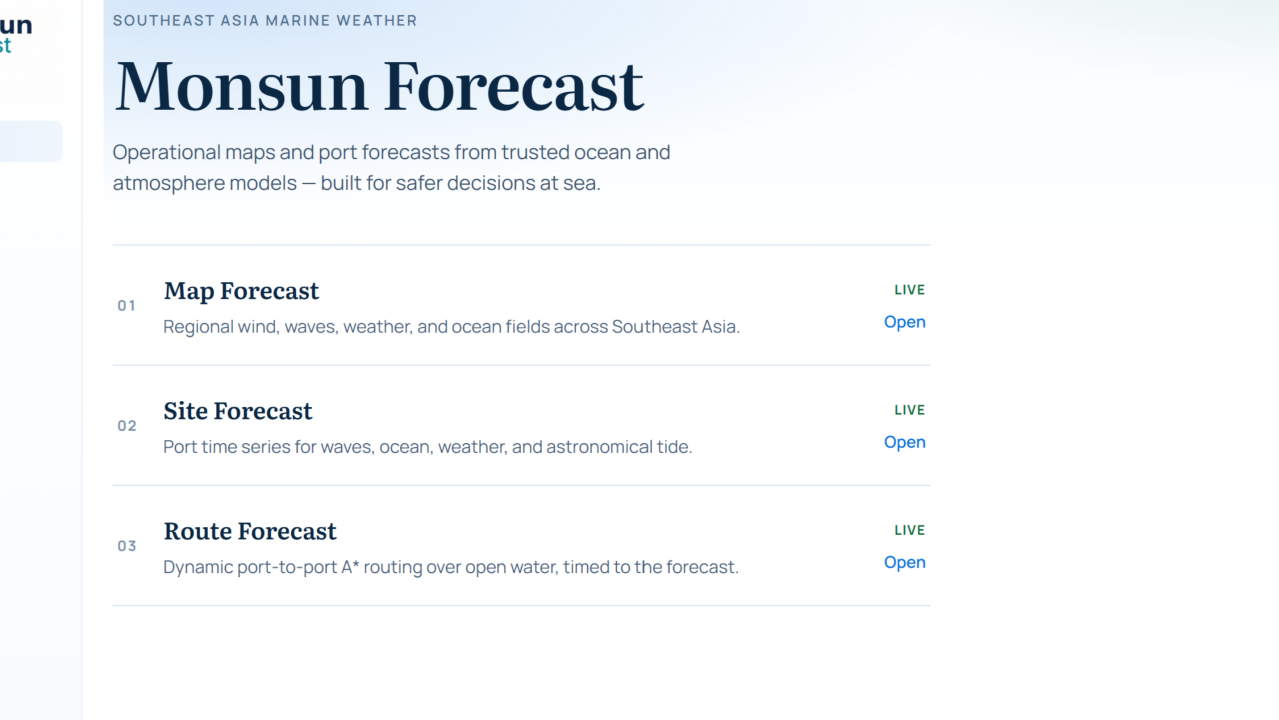
Monsun is a weather and marine forecasting platform developed with a particular focus on Southeast Asia. Instead of treating weather as something that you simply look at, Monsun provides tools that can help you understand conditions at a specific location, or even along a route.
The platform currently provides forecasts for locations and ports, as well as route-based marine forecasts.
That distinction matters.
Imagine that you are planning a boat trip between two islands.
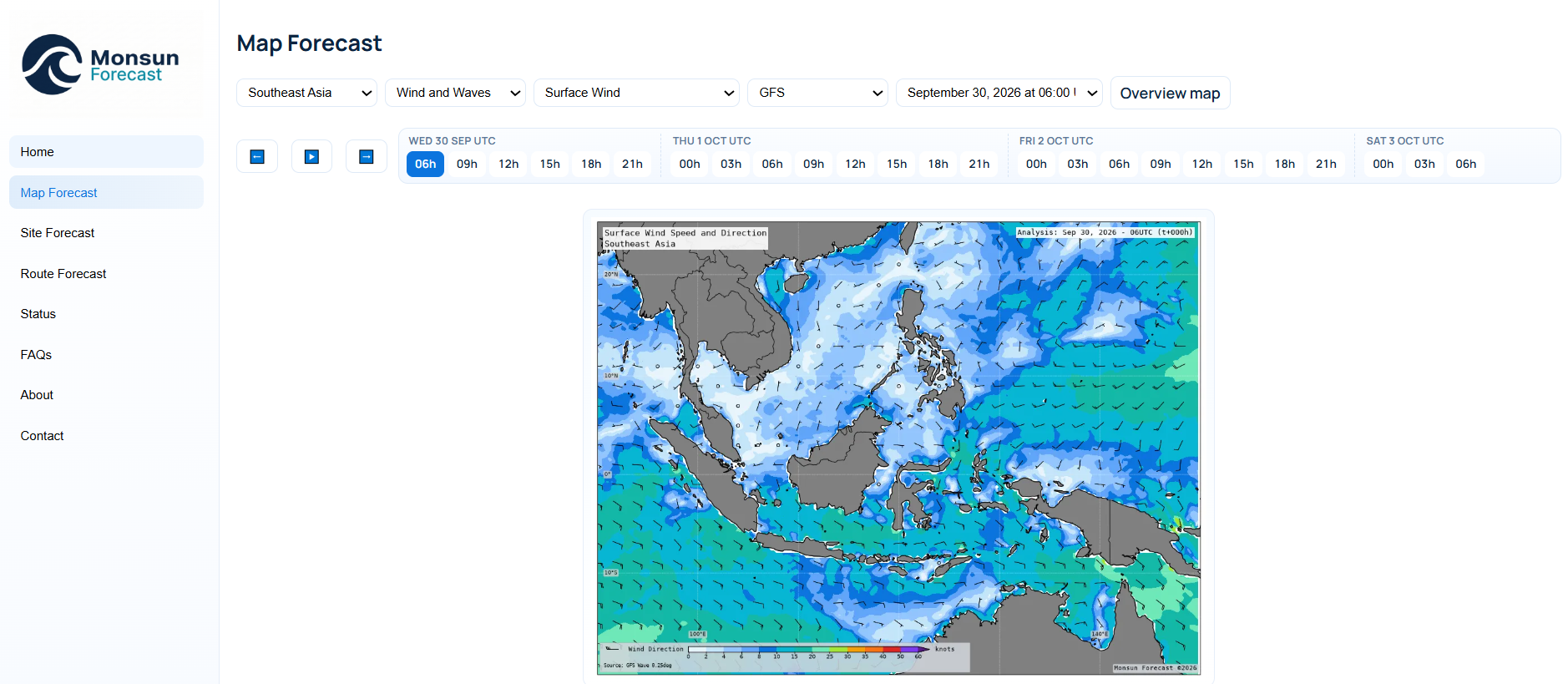
A conventional weather forecast might tell you the expected wind and wave conditions at several locations.
But your actual question is different:
"What conditions will I encounter during my trip?"
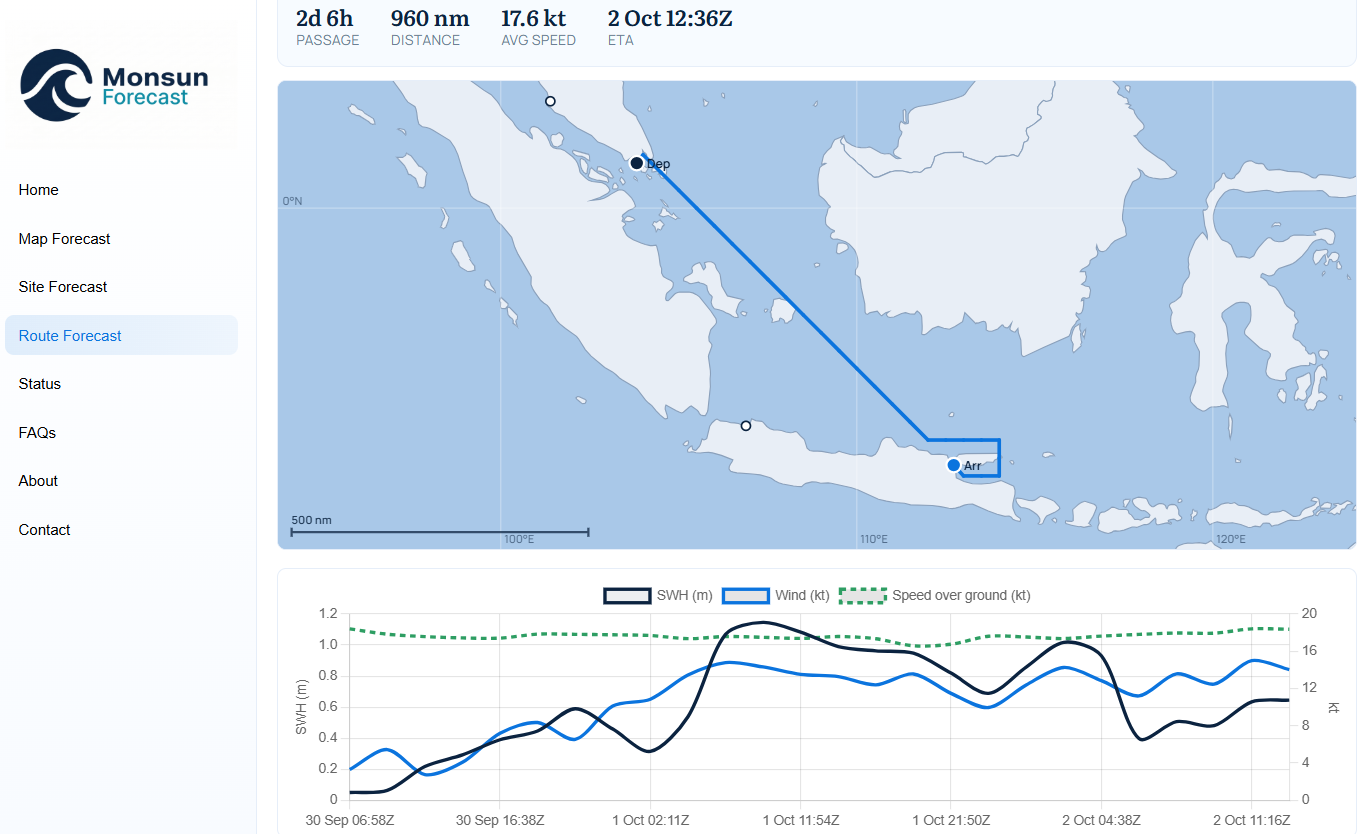
A route forecast can help answer that question by considering how the forecast conditions change along the journey.
That is much closer to how people actually make decisions.
Why marine weather deserves more attention
For people living in an island country such as Indonesia, weather and ocean conditions are not just background information.
They affect everyday life.
Whether it is fishing, ferry transportation, tourism, diving, marine construction, port operations, offshore activities, or coastal communities.
Even a relatively small change in wind, waves, or rainfall can change whether an activity is comfortable, practical, or potentially hazardous.
The ocean also behaves differently from the weather we experience on land.
A sunny afternoon does not necessarily mean calm seas. A location can experience relatively moderate local wind while waves generated somewhere else continue travelling into the area.
This is why marine forecasts require more than simply looking outside the window.
So what can you actually do with Monsun?
The easiest way to understand the platform is simply to try it.
Open: Monsun Forecast
You can explore forecast information for different locations and ports and examine conditions such as wind, waves, and other marine parameters.
But don't just look at the numbers.
Try asking a practical question.
"If I were going to sea tomorrow, what would I encounter?"
That changes the way you read a forecast.
Example 1: Planning a fishing trip
Suppose you are planning to leave early in the morning.
You don't necessarily need a meteorology degree.
You want to know:
- Will the wind be strong?
- Will the waves be uncomfortable?
- Will conditions deteriorate later?
- Is there a better departure time?
- What will conditions look like on the way back?
Instead of checking one forecast point and making a guess, you can explore the forecast conditions around your intended area and route.
The numbers become useful because they are connected to a real decision.
Example 2: Planning a boat trip
This is where the route forecast becomes particularly interesting.
Imagine a trip between two ports.
The weather at the departure point might look fine. But what happens halfway through the journey? And what about the return trip?
Conditions can change with both location and time.
A route forecast helps you think about the entire journey rather than treating the ocean as one uniform area.
That is a fundamentally better way to think about marine weather.
Example 3: Diving, surfing, or recreational activities
You don't have to be a professional mariner to benefit from marine forecasts.
If you are planning diving, snorkeling, surfing, sailing, fishing, island hopping, kayaking, or simply spending time near the coast, wind and wave conditions can make a major difference to the experience.
The difference between "The weather looks sunny" and "The wind and wave conditions should be relatively favorable during this particular window" is enormous.
The second statement is much closer to the information you actually need.
Don't be intimidated by the numbers
One reason people avoid professional forecast platforms is that they can look complicated.
You might see:
- Hs = 1.2 m
- Tp = 8 s
- Wind = 15 knots
- Direction = 210°
For someone who isn't familiar with marine meteorology, those numbers can seem meaningless. But they represent physical conditions that have very real consequences.
For example, significant wave height provides an indication of the overall sea state, while wave period provides information about the character and energy of the waves.
The important thing isn't memorizing every parameter. The important thing is learning to translate:
numbers → physical conditions → practical decision.
And that's a useful skill for anyone who regularly spends time on the water.
A different way to think about weather apps
Most weather applications answer: "What is the weather?"
A more useful forecasting platform tries to answer: "What will the environment be like where I am going?"
And an even more useful system eventually answers: "Given what I want to do, when and where are the better conditions?"
This is where the future of weather applications could become particularly interesting.
Instead of giving everyone exactly the same forecast, a system could interpret the same underlying forecast differently for different activities.
The underlying atmosphere and ocean haven't changed.
What changes is the question being asked.
Why platforms like Monsun are worth trying
The interesting thing about Monsun is not simply that it provides another weather map.
There are already plenty of weather maps.
The interesting part is its focus on marine conditions and practical forecasting for Southeast Asian waters, where reliable understanding of ocean conditions can be particularly important.
It also demonstrates an important idea:
Forecasting becomes more valuable when it is connected to a decision.
You don't check a forecast because you love looking at numbers.
You check it because you are trying to decide whether to do something — go fishing, take the boat, plan the trip, go diving, schedule marine work, choose a departure time, or avoid bad conditions.
Give it five minutes
You don't need to be a meteorologist or oceanographer to explore it.
Open Monsun Forecast, pick a location that you know, and look at the forecast.
Then ask yourself three simple questions:
- What will the wind do?
- What will the waves do?
- If I were actually going there, how would these conditions affect my plan?
That last question is the most important one.
Because the real value of a forecast isn't the number on the screen.
It's the decision that the number helps you make.
And once you start looking at weather that way, you may never look at a forecast quite the same way again.
Originally published on LinkedIn · 11 October 2026